

 Web search
 Links
Links Notes
Notes Files
Files Articles
 Contacts
 Home
Home Dashboard
 Tasks
Tasks Projects
 Messages
 Events
 Time tracker
 Forum
Forum Documentation
 Shell
Shell Workers
 Templates
 AI dashboard
 AI usage
 APIs & MCP
 Objects
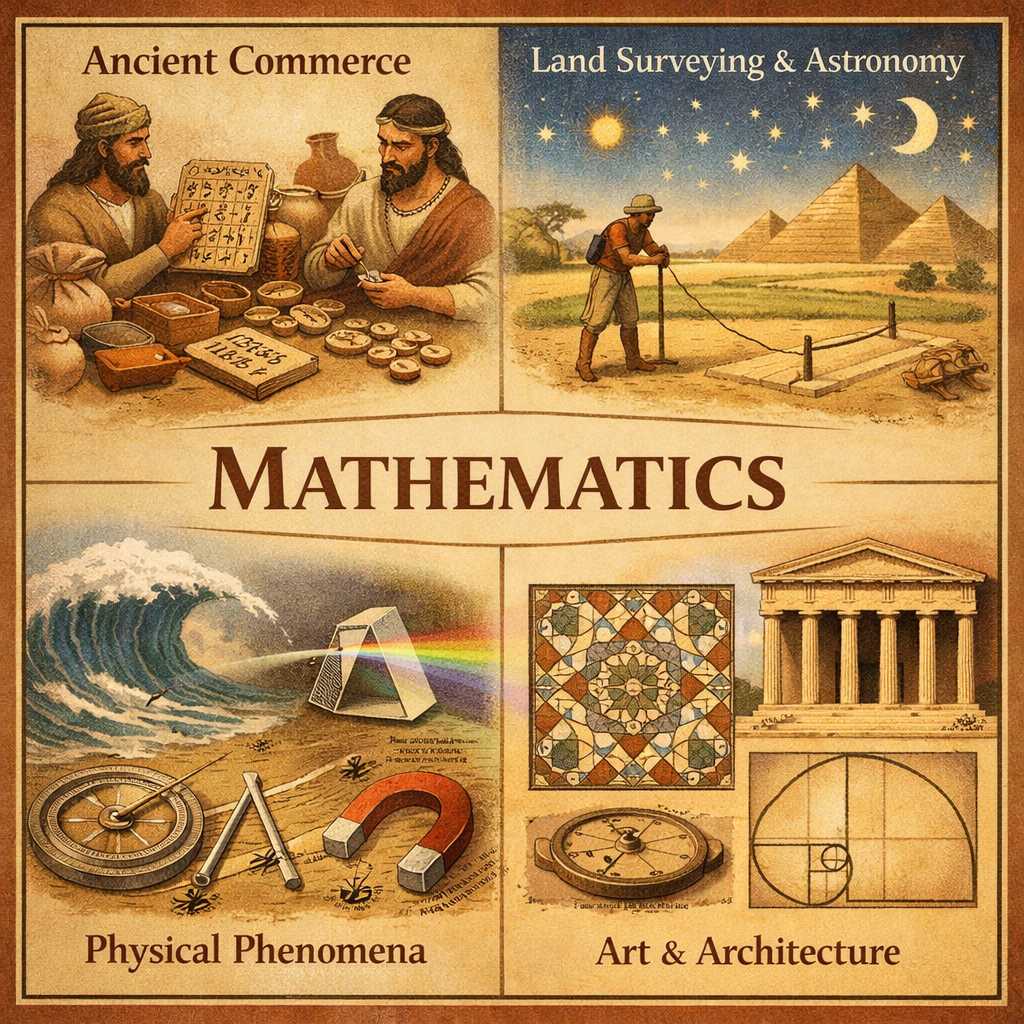
# Where Mathematics Came From
## Plain English first
Mathematics was not invented by professors in a room deciding to make things difficult.
It was forced into existence, repeatedly, by people trying to solve urgent real problems: How much do I owe you? How big is this field? When will the flood come? Why does light bend like that? How do I build a dome that won't collapse?
Every branch of mathematics has a practical ancestor. Understanding where each idea came from makes it far less abstract — and far easier to remember.
---
## Origin 1 — Commerce and Civil Administration
The oldest mathematical records we have are accounting records.
Mesopotamian clay tablets from 3000 BCE are not poetry or philosophy. They are lists: grain received, grain distributed, workers paid, debts owed. The Egyptians kept tax records. The Romans managed military supply chains. Every empire ran on arithmetic.
**What commerce forced into existence:**
| Problem | Math invented |
|---------|--------------|
| How much do I owe? | Addition and subtraction |
| Split this among 5 people | Division, fractions |
| 40 baskets at 3 coins each | Multiplication |
| What percentage is the tax? | Ratios, percentages |
| Track profit and loss | Positive and negative numbers |
| Standardize weights and measures | Units, conversion |
Negative numbers existed informally as debt long before they were accepted as "real" numbers. Fractions were used in trade for centuries before anyone wrote them as `a/b`. The need came first; the formalism followed.
```python
def compute_merchant_profit(
quantity_of_goods_sold,
price_per_unit,
cost_per_unit,
tax_rate_as_decimal
):
"""
A Mesopotamian merchant's core calculation.
Revenue minus cost minus tax equals profit.
This is exactly the arithmetic that forced number systems into existence.
"""
total_revenue = quantity_of_goods_sold * price_per_unit
total_cost = quantity_of_goods_sold * cost_per_unit
gross_profit = total_revenue - total_cost
tax_owed = gross_profit * tax_rate_as_decimal
net_profit = gross_profit - tax_owed
return net_profit
profit = compute_merchant_profit(
quantity_of_goods_sold=100,
price_per_unit=3,
cost_per_unit=2,
tax_rate_as_decimal=0.10
)
print(f"Net profit: {profit} coins") # 90.0 coins
```
---
## Origin 2 — Land, Navigation, and Surveying
The word **geometry** comes from Greek: *geo* (earth) + *metron* (measure). It literally means earth measurement.
Every spring in ancient Egypt, the Nile flooded and erased farm boundaries. Every year, surveyors had to re-measure and re-divide the land. They needed to calculate areas of irregular fields, mark right angles, and find distances they could not walk directly.
Navigation at sea created the same pressure. To sail from port to port, sailors needed to know angles, distances, and how to use the stars as a coordinate system. This forced trigonometry into existence centuries before anyone studied it for its own sake.
**What land and navigation forced into existence:**
| Problem | Math invented |
|---------|--------------|
| How big is this field? | Area formulas, geometry |
| Is this corner a right angle? | Pythagorean theorem |
| How far to the harbor? | Trigonometry, coordinate geometry |
| Where are we on the ocean? | Astronomy, spherical geometry |
| What angle does this slope make? | Sine, cosine, tangent |
| When does the season change? | Calendars, cycles, modular arithmetic |
```python
def compute_field_area_by_triangulation(
list_of_corner_coordinates
):
"""
Ancient surveyors broke irregular fields into triangles,
computed each triangle's area, then summed them.
This is still how modern GIS software measures land area.
Uses the Shoelace formula — discovered by Gauss, but
the underlying idea is as old as Egyptian surveying.
"""
number_of_corners = len(list_of_corner_coordinates)
running_sum = 0
for index in range(number_of_corners):
current_corner = list_of_corner_coordinates[index]
next_corner = list_of_corner_coordinates[(index + 1) % number_of_corners]
cross_product = (current_corner[0] * next_corner[1]) - \
(next_corner[0] * current_corner[1])
running_sum += cross_product
area = abs(running_sum) / 2
return area
field_corners = [(0, 0), (10, 0), (12, 7), (5, 9), (0, 6)]
area = compute_field_area_by_triangulation(field_corners)
print(f"Field area: {area} square units")
```
---
## Origin 3 — Astronomy and Prediction
Every ancient civilization watched the sky. Not for romance — for survival. The position of the sun determined planting season. The moon drove tidal fishing. Eclipses needed to be predicted so they did not cause panic.
Astronomy is what pushed arithmetic into algebra and geometry into trigonometry. To predict where a planet would be in 200 days, you needed equations with unknowns. To compute angles between stars, you needed the unit circle. To model orbits, you eventually needed calculus.
**What astronomy forced into existence:**
- Precise angle measurement → trigonometry
- Predicting cyclical events → modular arithmetic, sequences
- Understanding orbits → conic sections, later calculus
- Calendar design → fractions, remainders, number theory
The Babylonians could predict lunar eclipses using arithmetic sequences. The Greeks modeled planetary orbits with geometry. Newton invented calculus specifically to describe the mathematics of orbital motion.
---
## Origin 4 — Physical Phenomena
As humans built instruments and experimented, nature kept revealing patterns that demanded new mathematics.
**Optics:** Light bends when it passes through water. The angle of bending follows a precise ratio (Snell's Law). Understanding this required ratios, trigonometry, and eventually wave equations.
**Mechanics:** A cannonball's path is a parabola. Pendulums swing in predictable arcs. These patterns demanded algebra and, eventually, calculus — the mathematics of continuous change.
**Electricity and magnetism:** The force between charges follows an inverse-square law (like gravity). Circuits follow precise equations relating voltage, current, and resistance. Maxwell described all of electromagnetism in four equations using calculus and vector fields.
**Waves and signals:** Sound, light, and radio are all waves. Understanding them required Fourier analysis — the discovery that any repeating signal can be broken into simple sine and cosine components.
**Quantum mechanics:** At the subatomic level, particles don't have definite positions — they have probabilities. This forced an entirely new kind of mathematics: probability amplitudes, complex numbers, and operators.
The pattern: every time a new physical domain was studied seriously, it demanded mathematics that did not yet exist — and mathematicians invented it.
---
## Origin 5 — Art, Architecture, and Pattern
Not all mathematics was forced by necessity. Some was pulled by beauty.
The ancient Greeks noticed that certain proportions felt right — the golden ratio, the relations between musical intervals, the perfection of the circle. Islamic artists developed geometric tiling patterns of extraordinary complexity, discovering group theory centuries before it was formalized. Renaissance architects used perspective geometry to create the illusion of depth on flat walls.
**What art and architecture revealed:**
| Observation | Math discovered |
|-------------|----------------|
| Some proportions feel perfect | Golden ratio, continued fractions |
| Repeating tile patterns | Symmetry groups, tessellation |
| A dome doesn't collapse if built right | Structural geometry, force distribution |
| Perspective depth on flat canvas | Projective geometry |
| Musical intervals sound harmonious | Ratios, number theory |
| Fractals in nature | Recursive patterns, fractal geometry |
These were not applications of known mathematics. They were discoveries made through looking carefully at patterns — the fourth face of mathematics.
---
## The arc: from practical to abstract to universal
Mathematics follows a recurring path:
```text
1. Urgent practical problem
↓
2. Pattern noticed and used informally
↓
3. Pattern written down and generalized
↓
4. Abstract structure discovered underneath
↓
5. Abstract structure turns out to be useful
in completely unrelated domains
```
Number theory was studied as pure abstraction for centuries before it became the foundation of modern cryptography. Non-Euclidean geometry was invented as a curiosity and became the mathematical language of general relativity. Complex numbers were considered fictional until they became essential for electrical engineering and quantum mechanics.
The mathematics invented to count grain turns out to describe the behavior of subatomic particles. The geometry invented to measure fields turns out to describe the shape of spacetime.
This is why mathematics is both invented and discovered — the tools are invented by humans solving specific problems, but the patterns those tools reveal were waiting to be found.
---
## See also
- [What Is a Number?](/articles/8510b9a8-a3ad-4790-a928-b2360ac8679e)
- [Zero — The Number That Changed Everything](/articles/6995c841-40bf-4d34-a787-c459d6084b5d)
- [Visual Triangle Geometry](/articles/794e2e02-16a0-43fc-955a-ab27f8d1de8d)
- [Visual Calculus for Programmers](/articles/cbda355b-86cb-4c12-aebb-de239c2eb6b4)
- [Math Foundations — Visual Table of Contents](/articles/d404884f-54fc-4289-b3f1-baaad2bec6b2)