

 Web search
 Links
Links Notes
Notes Files
Files Articles
 Contacts
 Home
Home Dashboard
 Tasks
Tasks Projects
 Messages
 Events
 Time tracker
 Forum
Forum Documentation
 Shell
Shell Workers
 Templates
 AI dashboard
 AI usage
 APIs & MCP
 Objects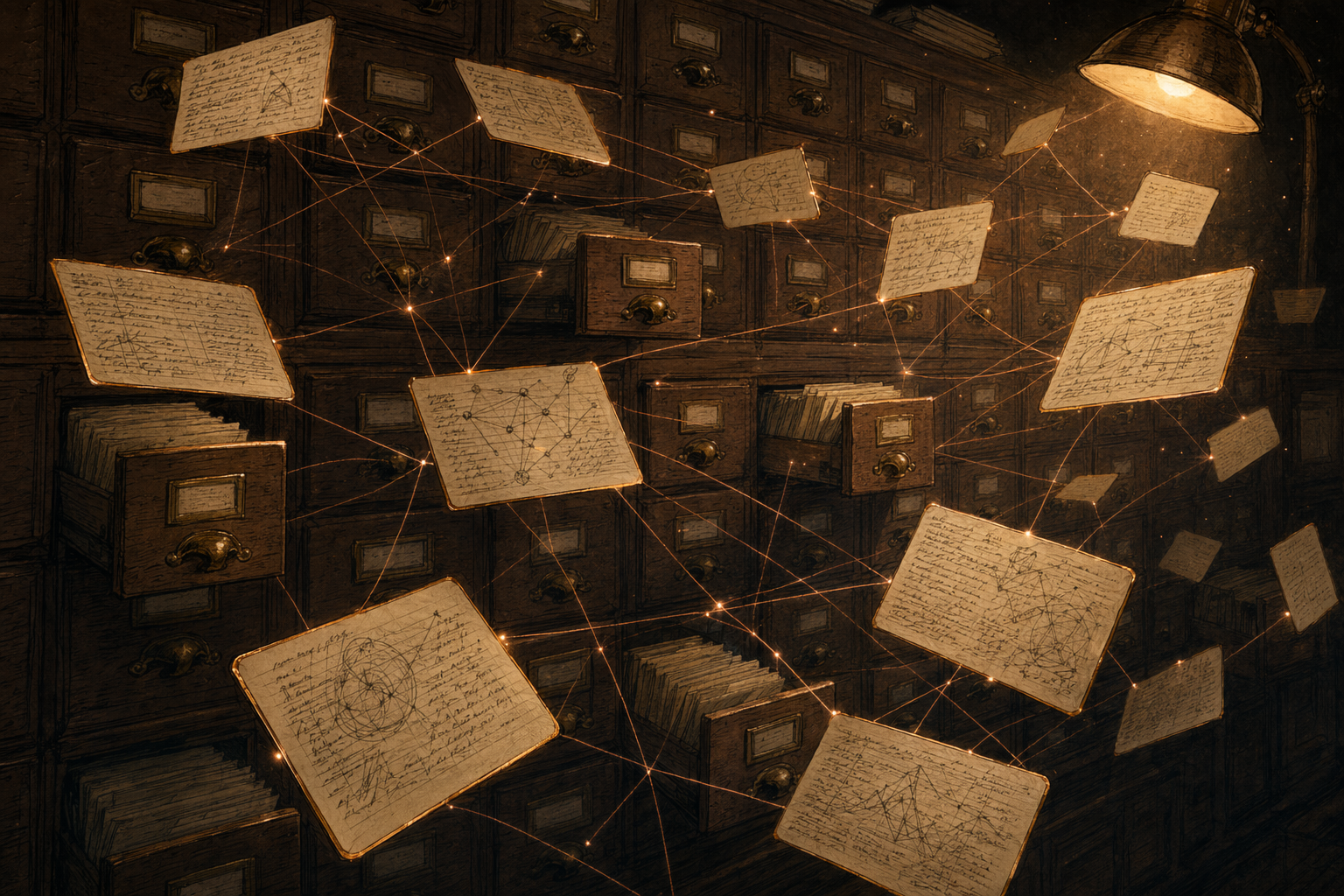
Niklas Luhmann wrote 70 books and 400 academic papers using a system of paper index cards he called the Zettelkasten. He filled 90,000 cards over 30 years. Each card had a unique number, atomic ideas, and links to other cards. The system became famous decades after his death when *How to Take Smart Notes* by Sönke Ahrens introduced it to a wider audience.
Modern tools — Obsidian, Roam, Logseq — were built explicitly on the Zettelkasten model. The principle: atomic notes, dense linking, emergent structure. Don't organize hierarchically; let the network of links create the structure. The collection thinks for you.
Luhmann's system worked because of three disciplines:
1. **Atomic notes** — one idea per card. If you had two ideas, you split them.
2. **Dense linking** — every new card connected to existing cards. The links were the value.
3. **Index cards** — physical retrieval forced him to actually traverse the network.
The disciplines are hard, especially the linking. Zettelkasten enthusiasts spend a lot of energy debating link practices: should you link atomically or thematically, when should you create a new card vs append, how do you maintain Maps of Content (MOCs).
The honest assessment is that Luhmann had 30 years and a job that rewarded note-taking as a primary activity. Most of his disciples don't. They abandon the system at the linking step — they capture notes but never connect them, and end up with a graph database that's structurally identical to a notes app.
What if the linking was a suggestion, not a chore?
AskRobots can do most of the work of the Zettelkasten without the discipline tax:
**Auto-suggested links.** When you create a new note, AI surfaces existing notes related to its content. You don't have to remember what you've written; the system tells you what connects.
**Atomization on demand.** A long note about three ideas can be split by AI into three atomic notes with bidirectional links. You can write naturally and let the structure emerge afterward.
**Emergent themes.** Instead of you creating MOC pages manually, AI identifies clusters and proposes structure. The "what is this collection about" question gets answered by the collection itself.
**Network traversal via natural language.** You don't navigate the graph by clicking links. You ask "what have I written about X" and get back the relevant subgraph.
The risk Zettelkasten purists will name: if AI does the linking, you lose the cognitive benefit of doing it yourself. Luhmann's argument was that the act of linking was itself thinking. That's true. But it's also the thing that kills adoption for everyone who isn't a tenured sociology professor with three decades to spare.
The right framing isn't "AI replaces your thinking." It's "AI does the linking labor that nobody actually does, so the network you imagined when you set up Obsidian actually exists." Luhmann had the discipline. You probably don't. AskRobots makes the system work without requiring the discipline.
There's also the deeper move: a Zettelkasten doesn't have to be only notes. Your contacts, projects, files, and tasks all link to your notes implicitly. AI can surface these cross-domain connections that pure-text Zettelkasten tools can't see. A meeting note links to the contact who attended, who links to the project they work on, which links to the deliverable file. The network expands beyond text to your whole information substrate.
If you've set up an Obsidian vault, downloaded the linking plugin, and ended up with 200 disconnected notes — this is what's different now.