

 Web search
 Links
Links Notes
Notes Files
Files Articles
 Contacts
 Home
Home Dashboard
 Tasks
Tasks Projects
 Messages
 Events
 Time tracker
 Forum
Forum Documentation
 Shell
Shell Workers
 Templates
 AI dashboard
 AI usage
 APIs & MCP
 Objects
# Visual Pi Dependencies
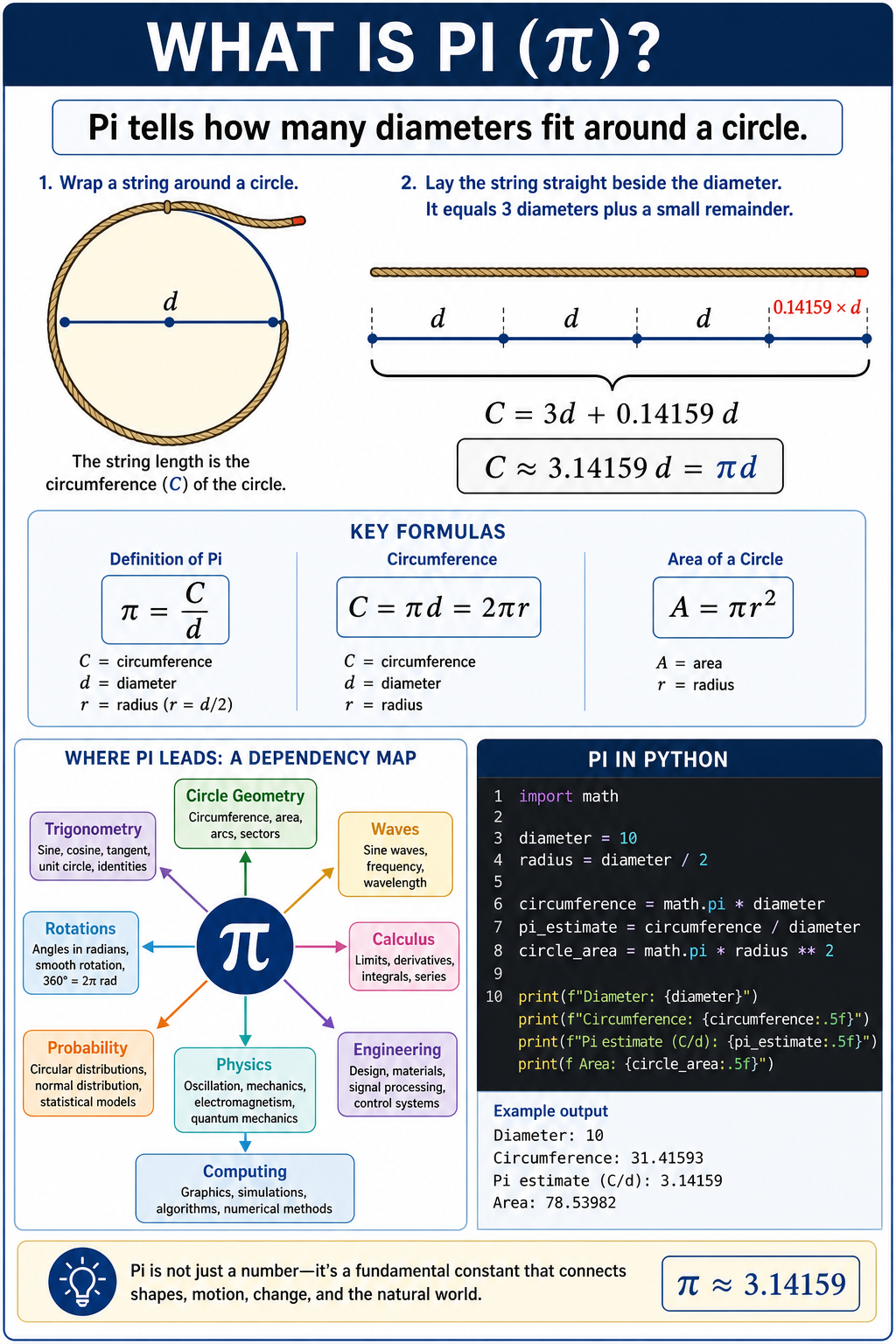
## Plain English first
Take any circle — a coin, a wheel, the sun. Measure around the outside edge (the circumference). Measure straight across through the middle (the diameter).
Divide: circumference ÷ diameter.
You always get the same number: about 3.14159…
That number is **pi**. It never changes, for any circle, any size. Pi is a fact about circles, not a choice anyone made.
## Standard math notation
```text
π = C / d
Where:
C = circumference (distance around the circle)
d = diameter (distance across through the center)
Rearranged:
C = πd
C = 2πr (since d = 2r)
```
## Verbose Python with descriptive names
```python
PI = 3.141592653589793 # the ratio of circumference to diameter, always
def compute_circumference_from_diameter(diameter_of_circle):
"""
Given how wide a circle is, find how long its outer edge is.
The outer edge is always π times the width.
"""
circumference = PI * diameter_of_circle
return circumference
def compute_circumference_from_radius(radius_of_circle):
"""
Given the distance from center to edge, find the outer edge length.
The diameter is twice the radius, so circumference is 2π times radius.
"""
circumference = 2 * PI * radius_of_circle
return circumference
def compute_area_of_circle(radius_of_circle):
"""
The area enclosed by a circle grows with the square of the radius.
This formula comes from integrating 2πr from 0 to r.
"""
area = PI * radius_of_circle * radius_of_circle
return area
# Pi can also be computed from a series (no library needed, just slow)
def estimate_pi_using_leibniz_series(number_of_terms):
"""
The Leibniz formula: π/4 = 1 - 1/3 + 1/5 - 1/7 + ...
More terms = more accurate, but this series converges slowly.
"""
running_total = 0
for term_index in range(number_of_terms):
numerator = 1
denominator = 2 * term_index + 1
sign = (-1) ** term_index # alternates +1, -1, +1, -1...
running_total += sign * numerator / denominator
return 4 * running_total
print(estimate_pi_using_leibniz_series(1_000_000)) # ≈ 3.14159...
```
## Where pi shows up
Pi appears wherever a calculation involves circles, rotation, or waves:
```text
circle shape → C = 2πr, A = πr²
rotation angle → full turn = 2π radians
sine/cosine → repeat every 2π
Fourier series → signal analysis
normal curve → statistics (e^(-x²) involves √π)
```
## Common mistakes
- Confusing diameter and radius. `C = πd` uses diameter. `C = 2πr` uses radius. Both are correct — just use the right one.
- Using `π ≈ 3` in real code. Just use the constant; precision is free.
- Thinking pi is approximate. Pi is exact — it's our decimal representation that goes on forever.
## See also
- [Visual Radians Without Math Libraries](/articles/7090a8d6-5f02-456e-82ec-31741bd1fe38) — pi connects directly to radians
- [Visual Degrees vs Radians](/articles/4bc70fd7-fa6e-4989-988f-834ff34babdf)
- [Visual Geometry and Trigonometry — Table of Contents](/articles/6e6fe0ba-ee87-48bd-9734-6fc7196323ac)