

 Web search
 Links
Links Notes
Notes Files
Files Articles
 Contacts
 Home
Home Dashboard
 Tasks
Tasks Projects
 Messages
 Events
 Time tracker
 Forum
Forum Documentation
 Shell
Shell Workers
 Templates
 AI dashboard
 AI usage
 APIs & MCP
 Objects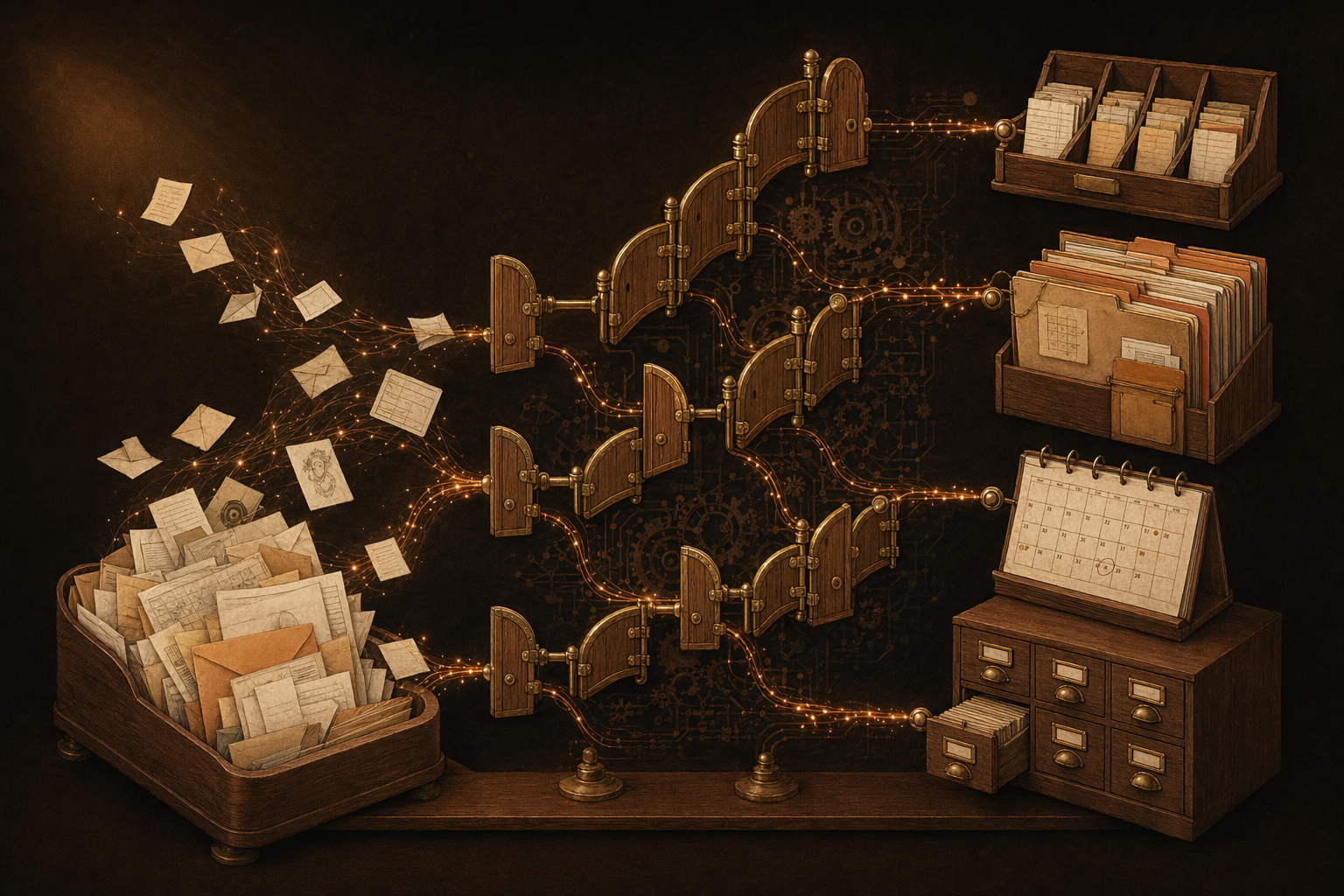
David Allen's *Getting Things Done* has sold over 2 million copies and is probably the most influential productivity book of the last 25 years. Almost everyone who reads it loves the framework. Almost no one keeps doing it.
The reason isn't that GTD is wrong. It's that GTD requires you to be the workflow engine.
The five steps — capture, clarify, organize, reflect, engage — are correct. The decision tree (is it actionable? what's the next action? project or single task?) is correct. The horizons of focus, the contexts, the someday/maybe list, the tickler file — all of it works when you do it.
The problem is "when you do it." GTD asks you to:
- Process every inbox to zero, every day or two
- Run a weekly review, every week, with no exceptions
- Re-categorize items as their context changes
- Maintain the next-actions list, the projects list, the waiting-for list, the someday/maybe list
This is a part-time job. The book glosses over how much time the system itself takes. Allen has acknowledged the weekly review is the hardest habit to keep — and the system rots without it.
Most GTD adopters follow the same arc: read the book, get excited, set up the system perfectly for two weeks, fall behind on the weekly review, watch the system decay, blame themselves, eventually quit. The flowchart on the wall becomes a relic.
What if the maintenance burden wasn't yours?
That's the bet AskRobots makes. The five GTD steps map to a substrate where AI does the maintenance work humans always abandoned:
**Capture** — multi-channel input. Type into a shell, ask the AI assistant, paste from email, snap a photo of a receipt, forward an event. Everything lands in one place. GTD's "ubiquitous capture" was always the easy part; we just have more capture surfaces now.
**Clarify** — AI does this automatically. Is this actionable? It can tell. Is it a project or a single next action? It can suggest. What's the appropriate context? It can infer. You don't have to process every item; you have to confirm the AI's processing.
**Organize** — already structured. Tasks go into tasks. Notes into notes. Contacts into contacts. Files into files. GTD flattened everything to lists because paper folders couldn't preserve type. Software can.
**Reflect** — this is where GTD died for everyone. The weekly review nobody did. AI does it continuously. You don't need a Friday afternoon ritual to surface stale tasks, deferred decisions, or projects without next actions. The review is happening every time the system updates.
**Engage** — AI surfaces "what should I work on next?" given full context: your calendar, your deadlines, your energy patterns. Not a list to scan but a recommendation to act on.
The core insight here isn't that AskRobots replaces GTD. It's that GTD was always describing a workflow that needed an engine. For 25 years the engine was you, and you got tired.
You still have to do the work. The next action still needs to get taken. AskRobots doesn't write the email or have the conversation. But the metawork — the capture, the clarification, the routing, the review — that part can be off your plate. Allen designed a system that worked perfectly if you treated maintenance as a sacred ritual. AI lets you treat it as background noise.
The followers of GTD who quit didn't quit because the framework was wrong. They quit because the framework asked too much of the human running it. AskRobots is GTD where the human runs the work and the system runs itself.
If you've ever felt the quiet shame of opening a stale GTD folder you haven't touched in three months — this is what's different now.