

 Web search
 Links
Links Notes
Notes Files
Files Articles
 Contacts
 Home
Home Dashboard
 Tasks
Tasks Projects
 Messages
 Events
 Time tracker
 Forum
Forum Documentation
 Shell
Shell Workers
 Templates
 AI dashboard
 AI usage
 APIs & MCP
 Objects
# Mathematics Has an Architecture Nobody Showed You
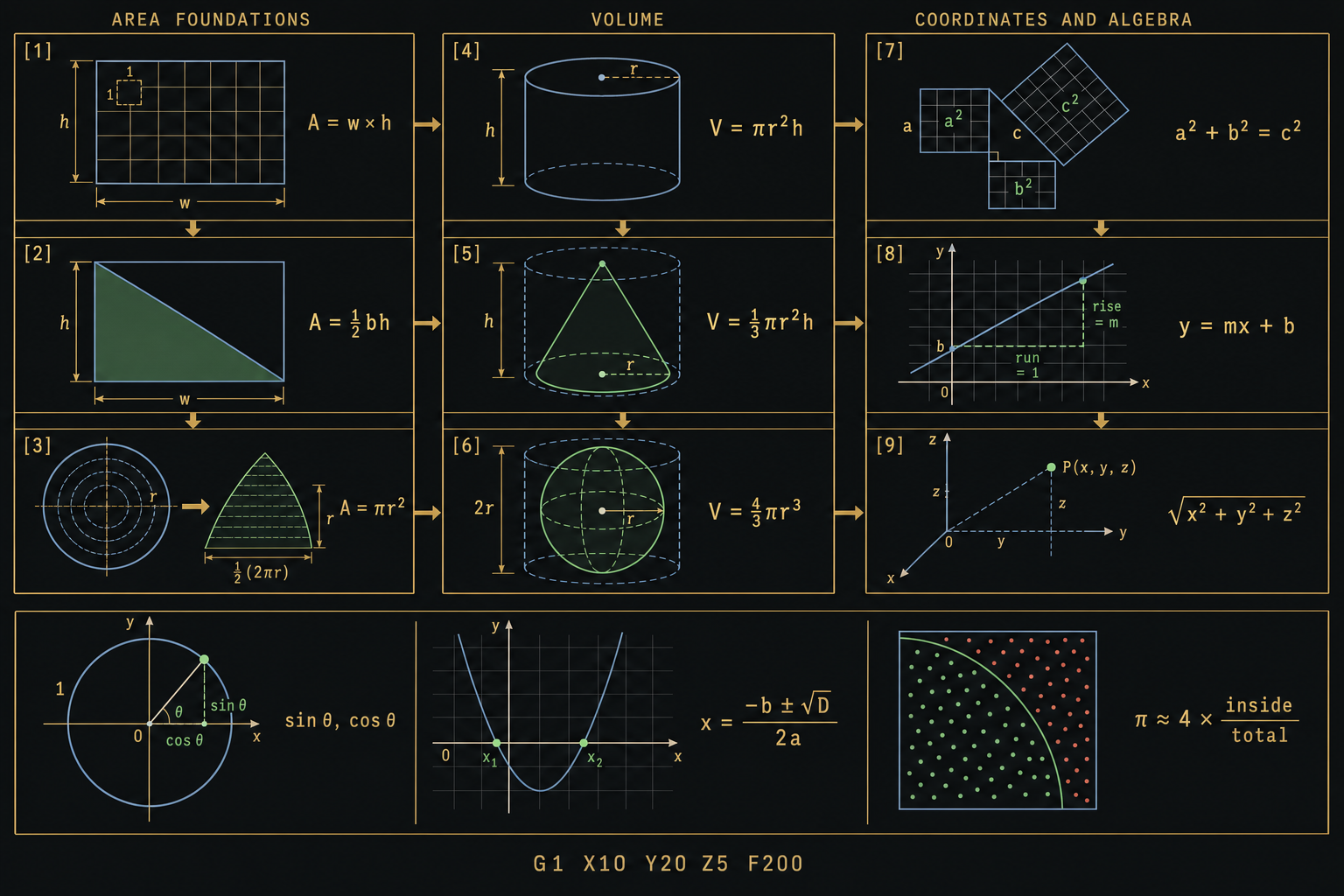
There is a moment, somewhere around the third time you drag a slider and watch a number update instantly, when you realize the formula was never the hard part.
The cylinder volume formula — V = πr²h — looks like notation. It looks like something you memorize for Friday and forget by Monday. But drag the radius slider and watch the shape grow, read the Python line that says `area_of_base_circle = math.pi * radius_of_base ** 2`, and a different thing happens. You see it. A cylinder is just a circle that someone decided to grow upward. The h is how tall you grew it. The πr² was already the circle. Stacking a circle h times is πr² × h. The formula isn't saying anything you don't already understand — it's just saying it faster.
That realization is the one nobody hands you directly.
---
## Where This Started
Around 1991, in an advanced algebra class in elementary school, a student tried to explain something to the class. Not the answer to a problem — the idea that you could use programming code to *understand* math. That the variables in a formula and the variables in a program were the same thing. That if you wrote the formula out with real words instead of single letters and ran it, the math would explain itself.
The teacher thought he was talking about a graphical calculator. He wasn't. He didn't have one.
He was removed from the class. The class, by most measures, was failing.
A year or two later, the school came back around and showed students how to write code inside a graphical calculator — TI-BASIC on a TI-82, which Texas Instruments had just released. It was presented as new curriculum. As if to prove him wrong, they demonstrated a worse version of the idea he had been removed for describing.
The concept didn't change. The packaging did. Once a $100 device from Texas Instruments made it official, it became something you could teach.
That was 35 years ago. This journal is the version that was actually possible all along. The tools just took this long to catch up.
---
## The Same Triangle, Three Times
Consider the right triangle.
You first encounter it in geometry, as a shape on paper. Then slope in algebra — rise over run. Then the distance formula — how far apart are two points on a grid? Three separate chapters. Often three separate years. Rarely connected.
They are the same object.
The slope triangle you draw when you measure steepness — the dashed rise line and dashed run line — is a right triangle. The hypotenuse is the line segment itself. Pythagorean theorem gives its length. When you write the distance formula, √((x₂−x₁)² + (y₂−y₁)²), you are writing Pythagorean theorem with the legs relabeled. Extend it to 3D — √(x² + y² + z²) — and you have added exactly one term. The triangle became a tetrahedron. The idea is identical.
A 3D printer moves to a coordinate (x, y, z) by sending `G1 X10 Y20 Z5 F200` to its stepper motors. The distance traveled for that move is — you already know — the square root of the sum of the squares. The machine is doing Pythagorean theorem several hundred times per second.
Mathematics is not a list of unrelated formulas. It is a small number of fundamental ideas that keep appearing in different contexts, wearing different names. The right triangle is everywhere. The ratio π is everywhere. The idea of stacking a flat area into a volume is everywhere. Once you recognize the same shape underneath different notation, the notation stops being the obstacle.
---
## The Architecture
There is a dependency tree hidden inside the standard curriculum.
Rectangle area is just counting squares: width × height. Triangle area is always exactly half a rectangle — draw any triangle, complete the rectangle around it, and the triangle fills precisely half. Circle area comes from unrolling concentric rings into a triangle, which is why the formula has that ½ × base × height shape underneath the πr². Cylinder volume is a circle grown tall. Cone volume is exactly one third of the cylinder that contains it — not approximately, not by convention, exactly one third, for every cone that has ever existed. Sphere volume is two thirds of the cylinder it fits inside, which is the result Archimedes was proudest of in his life and asked to have carved on his tombstone.
These are not separate topics. They are one topic — measuring space — told at increasing levels of dimension, each one building directly on the last.
The same tree exists on the coordinate side. Pythagorean theorem gives you the distance formula, which gives you the circle equation (just "all points at distance r from center," squared), which gives you 3D distance, which gives you the parametric equations that describe how anything moves through space.
Seeing this architecture changes how hard the subject feels. You are not memorizing twenty formulas. You are learning one idea and watching it generalize.
---
## What Schools Actually Optimized For
This is not an accusation. It is a historical observation.
Mathematics education was designed when calculation was the scarce skill. Long division by hand. Evaluating trig functions from a printed table. If you could do that reliably under time pressure, you were useful. The curriculum was built to identify people who could — to filter, not to teach. The abstraction-first approach — symbols before meaning, notation before intuition — served that purpose fine.
Computers now do every calculation that curriculum was testing. What remains valuable is the one thing it never taught: understanding what the formula means. Knowing when to use it. Seeing why it works. Recognizing the same right triangle in the slope problem and the distance problem and the 3D printer firmware.
The institution got stuck defending the approach. To admit the method was wrong would mean acknowledging what it cost every student who failed under it. So it stayed. And the people sorted out by it — told they weren't math people — often understood the concepts perfectly well. They just couldn't navigate the ceremony.
The tools to teach differently — interactive, immediate, visual, runnable — simply did not exist at scale until very recently.
---
## What Changes When You See the Code
Every page in this journal shows you the same concept four ways at once.
Plain English first — what is this, in human terms, before any symbols appear. Then the formula. Then Python with descriptive variable names: not `A` and `r`, but `area_of_base_circle` and `radius_of_base`. Then a canvas that responds when you move a slider.
The variable names matter more than they look like they do. `area_of_base_circle = math.pi * radius_of_base ** 2` contains exactly the same information as `A = πr²`, but it does not hide anything. Every word is spelled out. You could read it aloud and it would parse as English. The formula is not mysterious — it is English compressed into symbols, and the compression is what made it hard.
The slider is a different kind of question than "solve for x." When you drag it, you are asking: what happens if the radius is 7? What if the height doubles? The answer comes immediately, without algebra, and your brain records it as experience rather than procedure. That is how intuition forms — not from solving, but from experimenting.
There is no graphical calculator required. No account. No textbook. Just open a page.
---
## How to Use This Journal
Each page covers one formula. The pages connect. Circle area comes before cylinder volume because you need the circle to understand the cylinder. Pythagorean theorem comes before the distance formula because they are the same theorem. The 3D coordinates page shows the whole chain at once — slope to Pythagorean to 3D distance to G-code — because once you see the chain, none of the steps are surprising.
You do not need to go in order. You need a calculator for nothing. If the formula ever confuses you, read the Python. If the Python confuses you, read the plain English. If you want to understand where the formula came from, move the slider and watch what changes.
The goal is not to memorize. It is to see the shape underneath the notation — and once you see it, you cannot unsee it.