

 Web search
 Links
Links Notes
Notes Files
Files Articles
 Contacts
 Home
Home Dashboard
 Tasks
Tasks Projects
 Messages
 Events
 Time tracker
 Forum
Forum Documentation
 Shell
Shell Workers
 Templates
 AI dashboard
 AI usage
 APIs & MCP
 Objects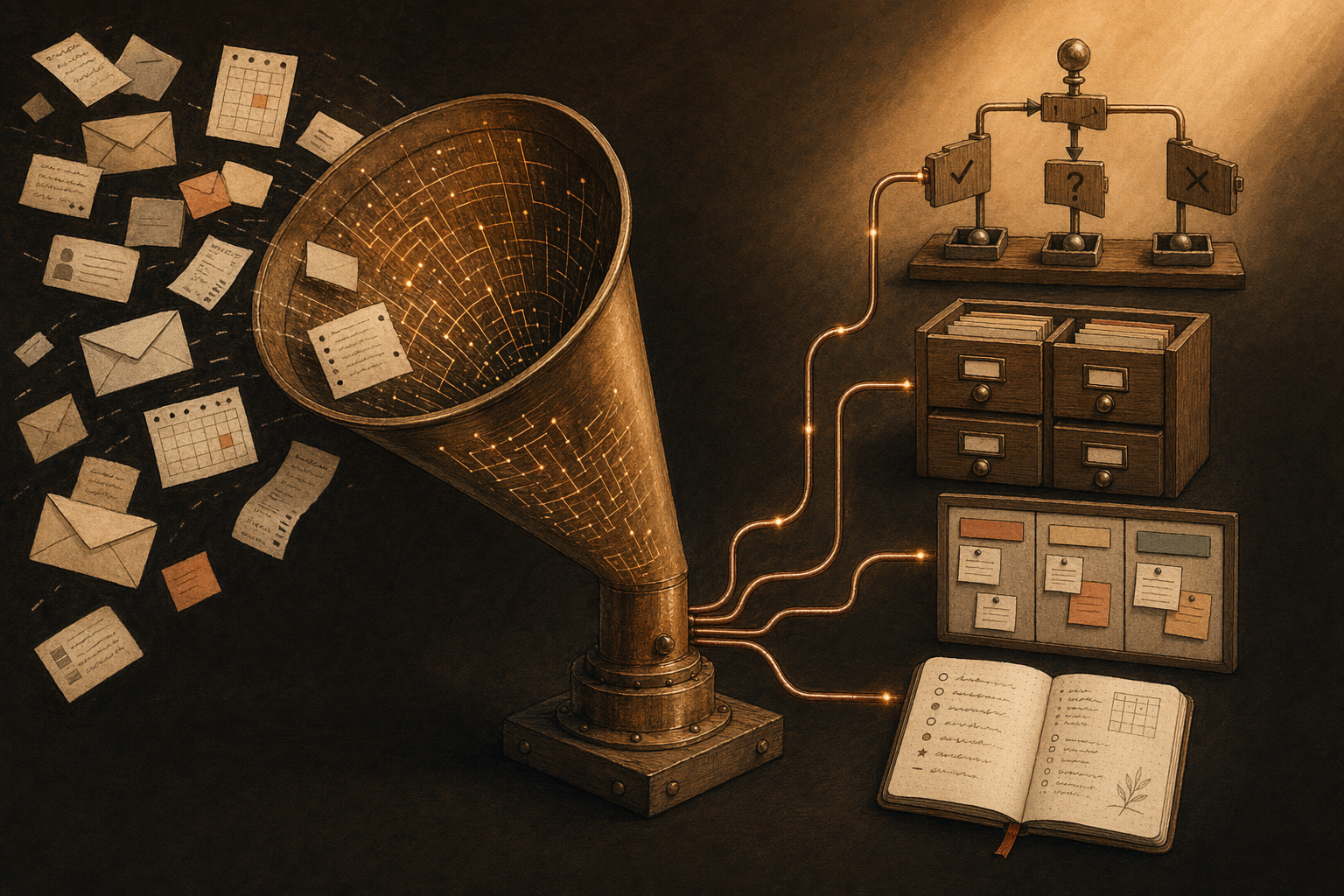
Every productivity system from the last 50 years describes the same loop. Capture inputs. Process them. Organize them. Review them. Act on them.
GTD calls it capture-clarify-organize-reflect-engage. PARA calls it Projects-Areas-Resources-Archive. Bullet Journal calls it rapid-logging-migration-indexing. Personal Kanban calls it visualize-WIP-pull-policy. Inbox Zero calls it process-once-decide-immediately. Deep Work calls it batch-shallow-protect-deep. Atomic Habits calls it identity-environment-compound-stack. Pomodoro calls it block-focus-break-repeat. Time Blocking calls it commit-execute-replan. Shape Up calls it shape-bet-execute-cool-down.
They are all describing the same fundamental shape. Different vocabularies, different metaphors, slightly different emphases. But the underlying loop is the same.
The reason there are so many systems isn't that we keep discovering new truths. It's that **each system is a UI choice on top of the same data**. GTD treats everything as actions. PARA treats everything as files. Bullet Journal treats everything as logged entries. Kanban treats everything as cards. Each metaphor preserves what its inventor cared about and flattens what they didn't.
The shape is the same. The interface is what changes.
This is why the question "which productivity system should I use?" is malformed. It assumes you have to pick one. Pick GTD and you get the action-driven view; you lose the intentional curation of BuJo. Pick PARA and you get the file-based hierarchy; you lose the daily flow of kanban. Pick Pomodoro and you get the focus blocks; you lose the bigger-picture cycles of Shape Up.
The systems weren't designed to be combined because they each assume they're the whole answer. They aren't. They're partial answers that overlap in significant ways.
What if the system underneath was just data, and any of these methodologies could be a view on top?
That's what AskRobots is. Not a productivity app, not a single methodology, not "GTD software" or "PARA software" or "Kanban software." It's a substrate. Tasks, notes, contacts, files, events, finance — structured data that any framework can render.
If you want to think in GTD terms — capture into the inbox, process to next-actions, weekly review — the data supports that view.
If you want to think in PARA — Projects, Areas, Resources, Archive — the data supports that view.
If you want to think in Kanban — three columns, WIP limits, pull workflow — the data supports that view.
If you want to think in Bullet Journal — rapid logging with symbols, monthly migration — the data supports that view.
You can use one framework. You can use multiple. You can switch as your work evolves. You can ignore frameworks entirely and just use the underlying tools. The system doesn't care because the data is the substrate, not the interface.
This is the move that the productivity book authors couldn't make because they were trying to sell a framework. They had to be opinionated about the right way. AskRobots can be agnostic because the AI runs the maintenance work that all systems require, regardless of which framework is on top.
The followers of every framework discover the same problem: the system requires more discipline than the human can sustain. GTD's weekly review. PARA's filing decisions. BuJo's monthly migration. Kanban's flow management. Pomodoro's logging. Time Blocking's replanning. EOS's scorecards. Shape Up's hill charts.
The discipline isn't optional in any of these systems. It's the price of the system working. AI can pay that price for you.
The question stops being "which system" and becomes "which system fits this part of my life." Maybe GTD for personal tasks, PARA for reference notes, Kanban for active projects, Pomodoro for daily focus. The data underneath is the same. The interface flexes to whatever you need.
If you've read 5 productivity books, tried 5 systems, abandoned 5 systems, and felt like the problem was you — the problem was that each system was asking you to be the engine, and engines get tired. The substrate never does.