

 Web search
 Links
Links Notes
Notes Files
Files Articles
 Contacts
 Home
Home Dashboard
 Tasks
Tasks Projects
 Messages
 Events
 Time tracker
 Forum
Forum Documentation
 Shell
Shell Workers
 Templates
 AI dashboard
 AI usage
 APIs & MCP
 Objects
# Base 10 and Place Value
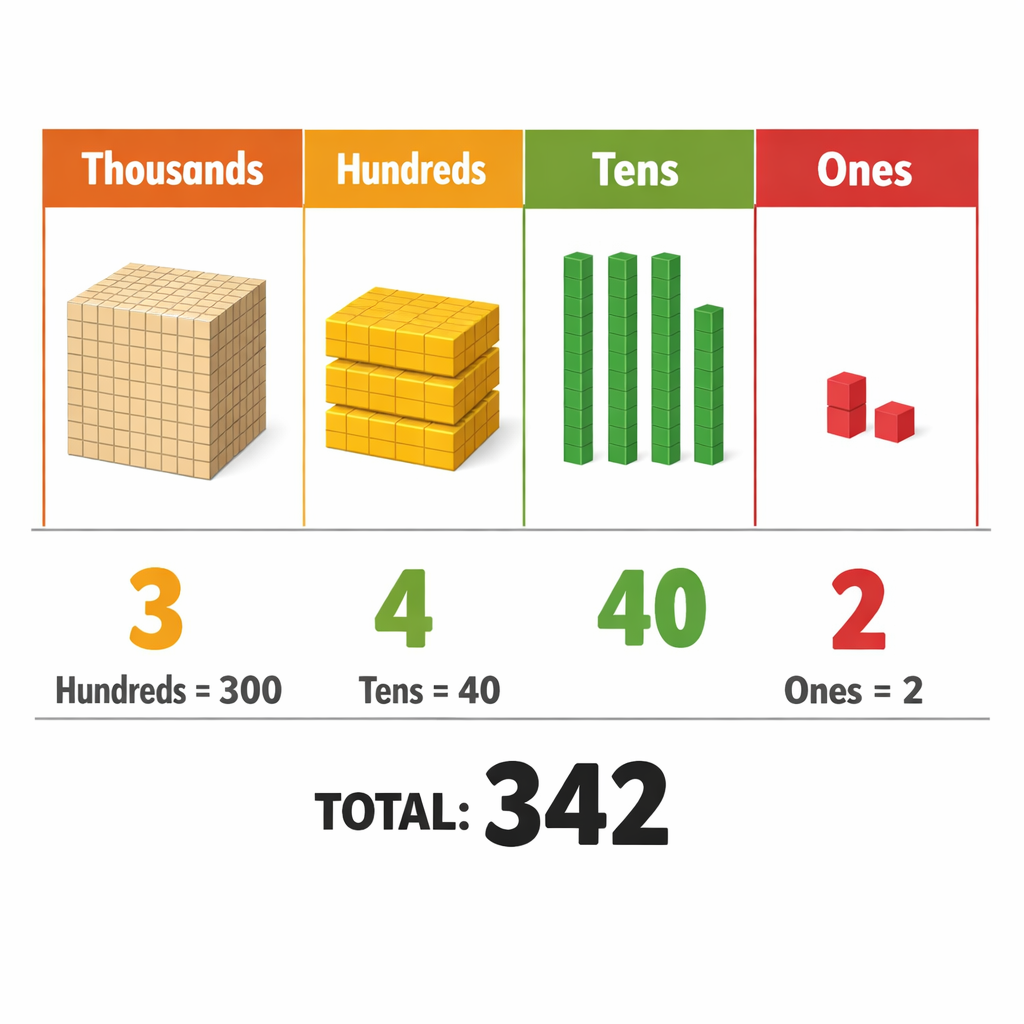
## Plain English first
We only have 10 digit symbols: 0, 1, 2, 3, 4, 5, 6, 7, 8, 9.
With just those 10 symbols we can write any number. The trick is **place value**: the position of a digit determines how much it is worth.
The digit `3` means three. But `300` means three hundreds. And `3000` means three thousands. Same symbol, completely different value depending on where it sits.
## The column system
Each column is worth ten times the one to its right:
```text
... | Thousands | Hundreds | Tens | Ones |
```
The number **4,302** means:
```text
4 thousands + 3 hundreds + 0 tens + 2 ones
= 4000 + 300 + 0 + 2
= 4,302
```
## Standard math notation
```text
N = d₃ × 10³ + d₂ × 10² + d₁ × 10¹ + d₀ × 10⁰
Example: 4302
= 4 × 1000 + 3 × 100 + 0 × 10 + 2 × 1
= 4000 + 300 + 0 + 2
```
## Verbose Python with descriptive names
```python
def break_number_into_place_values(whole_number):
"""
Decompose a number into the value each digit contributes.
Each column is worth 10× the column to its right — that's base 10.
"""
column_names = ["ones", "tens", "hundreds", "thousands",
"ten-thousands", "hundred-thousands", "millions"]
breakdown = {}
for position, digit_character in enumerate(reversed(str(whole_number))):
digit_value = int(digit_character)
column_worth = 10 ** position
value_in_column = digit_value * column_worth
column_label = column_names[position] if position < len(column_names) else f"10^{position}"
breakdown[column_label] = {"digit": digit_value, "contributes": value_in_column}
return breakdown
# Demonstration
breakdown = break_number_into_place_values(4302)
for column, data in breakdown.items():
print(f" {column:15s}: digit={data['digit']}, contributes={data['contributes']}")
# Sum confirms: 4000 + 300 + 0 + 2 = 4302
```
## Why base 10?
Probably because humans have 10 fingers. Other bases work identically:
- **Base 2 (binary)**: computers — only digits 0 and 1
- **Base 16 (hex)**: programming — memory addresses, colors (`#FF5733`)
- **Base 60**: ancient Babylonians — why we have 60 minutes and 60 seconds
## Common mistakes
- **The digit `4` in 4,302 is worth 4,000 — not 4.**
- **Dropping placeholder zeros.** 4,302 ≠ 432.
- **Thinking "ones" means unimportant.** Everything is built in multiples of the ones column.
## See also
- [Zero — The Number That Changed Everything](/articles/6995c841-40bf-4d34-a787-c459d6084b5d)
- [What Is a Number?](/articles/8510b9a8-a3ad-4790-a928-b2360ac8679e)
- [The Number Line](/articles/257eeafa-b654-40a8-97f5-6be800ad1c8e)
- [Math Foundations — Visual Table of Contents](/articles/d404884f-54fc-4289-b3f1-baaad2bec6b2)