

 Web search
 Links
Links Notes
Notes Files
Files Articles
 Contacts
 Home
Home Dashboard
 Tasks
Tasks Projects
 Messages
 Events
 Time tracker
 Forum
Forum Documentation
 Shell
Shell Workers
 Templates
 AI dashboard
 AI usage
 APIs & MCP
 Objects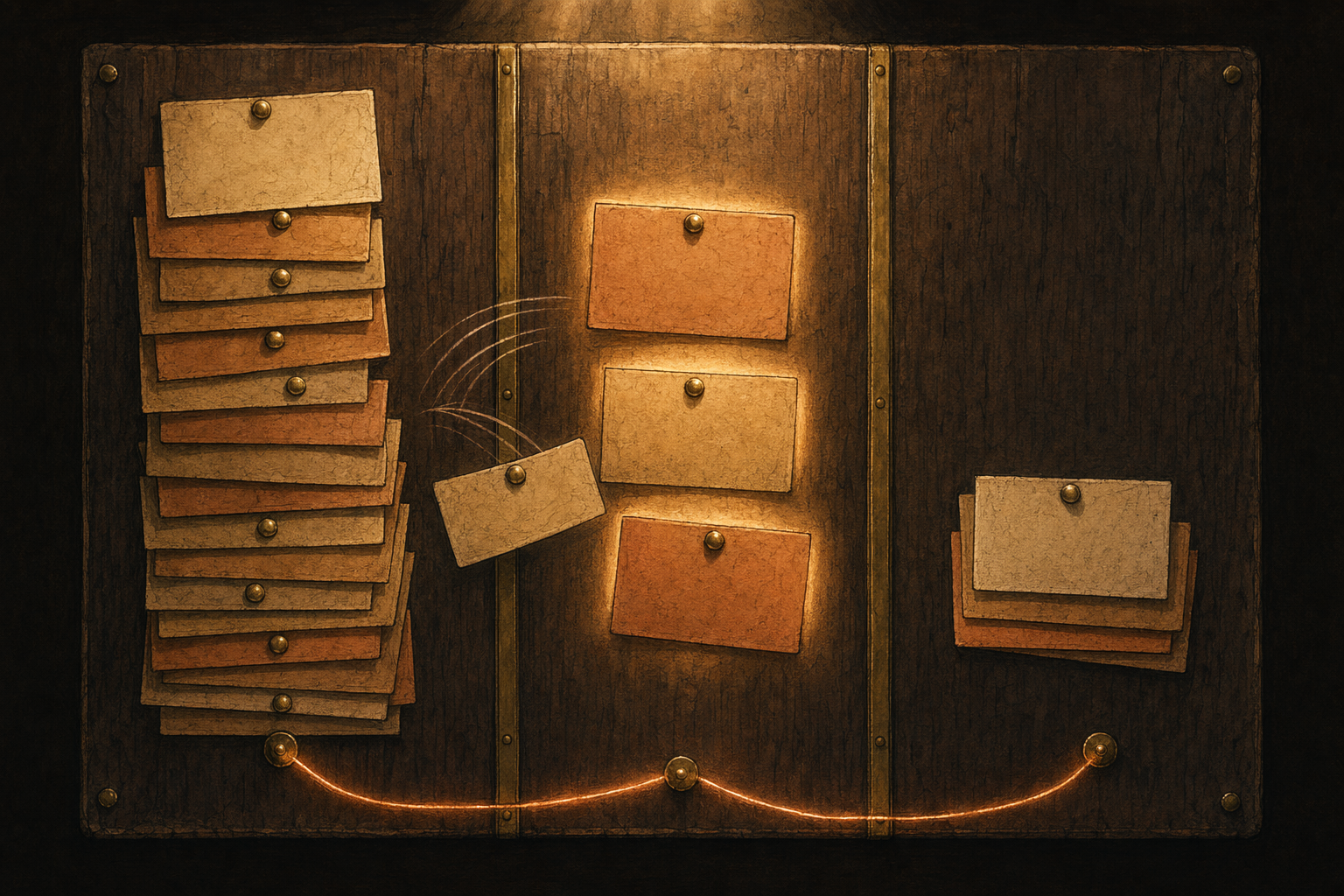
Jim Benson and Tonianne DeMaria popularized Personal Kanban with their 2011 book of the same name. It's the simplest personal productivity system that actually works: three columns on a board, cards that move from To Do → Doing → Done. Limit work in progress (WIP). Visualize the flow.
The system's strength is that it's hard to misunderstand. Anyone who has ever stuck a Post-it on a whiteboard already gets it. Trello built a billion-dollar company on top of this idea.
The disciplines are minimal:
1. **Visualize work** — write each task on a card
2. **Limit WIP** — don't take on more than you can actively do
3. **Pull, don't push** — finish current work before starting new
4. **Make policies explicit** — define what "done" means, what "blocked" means
That's it. The system is so light it's almost uncriticizable. People love it because it doesn't ask much.
But the cards stop moving when you stop moving them.
A personal kanban board works perfectly when you check it daily and act. It rots when you skip a few days. Cards in "Doing" stay there forever. New work piles up in "To Do." Nothing gets to "Done." The visualization that was supposed to give you flow becomes a static museum of your good intentions.
Worse, kanban doesn't tell you anything beyond what's on the board. It doesn't know if a card is stale, blocked, or just slow. It doesn't escalate. It doesn't surface dependencies. It's a passive tool that requires active discipline.
What if the board moved itself?
AskRobots can be Personal Kanban with built-in flow management:
- **Stale card detection.** A card that's been in "Doing" for 14 days is probably blocked, not progressing. AI flags it and asks: is this still active?
- **Dependency surfacing.** When a card in "To Do" is blocked by something not on the board, AI notices and asks if you want to track the dependency.
- **WIP limit enforcement.** When you try to start a fifth thing, AI reminds you of the WIP limit (and that you're four-deep in "Doing").
- **Cycle time tracking.** AI tracks how long cards typically take and warns you when an estimate looks unrealistic.
- **Done analytics.** Every week, AI shows you what shipped, what stalled, where time went. Not for performance review — for self-honesty.
The system is still kanban. Three columns, cards, WIP limits, pull workflow. The discipline is still yours. But the maintenance burden of detecting flow problems isn't.
There's also the cross-system view that pure kanban can't offer. A personal kanban board is one source of truth. Your tasks come from multiple places — email, meetings, conversations, ideas. Pure kanban requires you to manually copy them onto the board. AskRobots' kanban view can be built dynamically from any task in the system, regardless of how it was created.
The original Toyota production system that kanban was invented for had real-time signaling built in — a card was a physical pull request that moved through a manufacturing line, with humans at every station responding to the signal. Personal kanban lost that real-time signaling because there's just one human (you), and you can't signal yourself effectively. AI can play the role of the surrounding stations — surfacing signals, applying constraints, escalating anomalies.
If you've started a personal kanban, loved it for two weeks, and watched it ossify into a graveyard of in-progress cards — this is what's different now.