

 Web search
 Links
Links Notes
Notes Files
Files Articles
 Contacts
 Home
Home Dashboard
 Tasks
Tasks Projects
 Messages
 Events
 Time tracker
 Forum
Forum Documentation
 Shell
Shell Workers
 Templates
 AI dashboard
 AI usage
 APIs & MCP
 Objects
# Visual Inverse Trig and atan2 Without Math Libraries
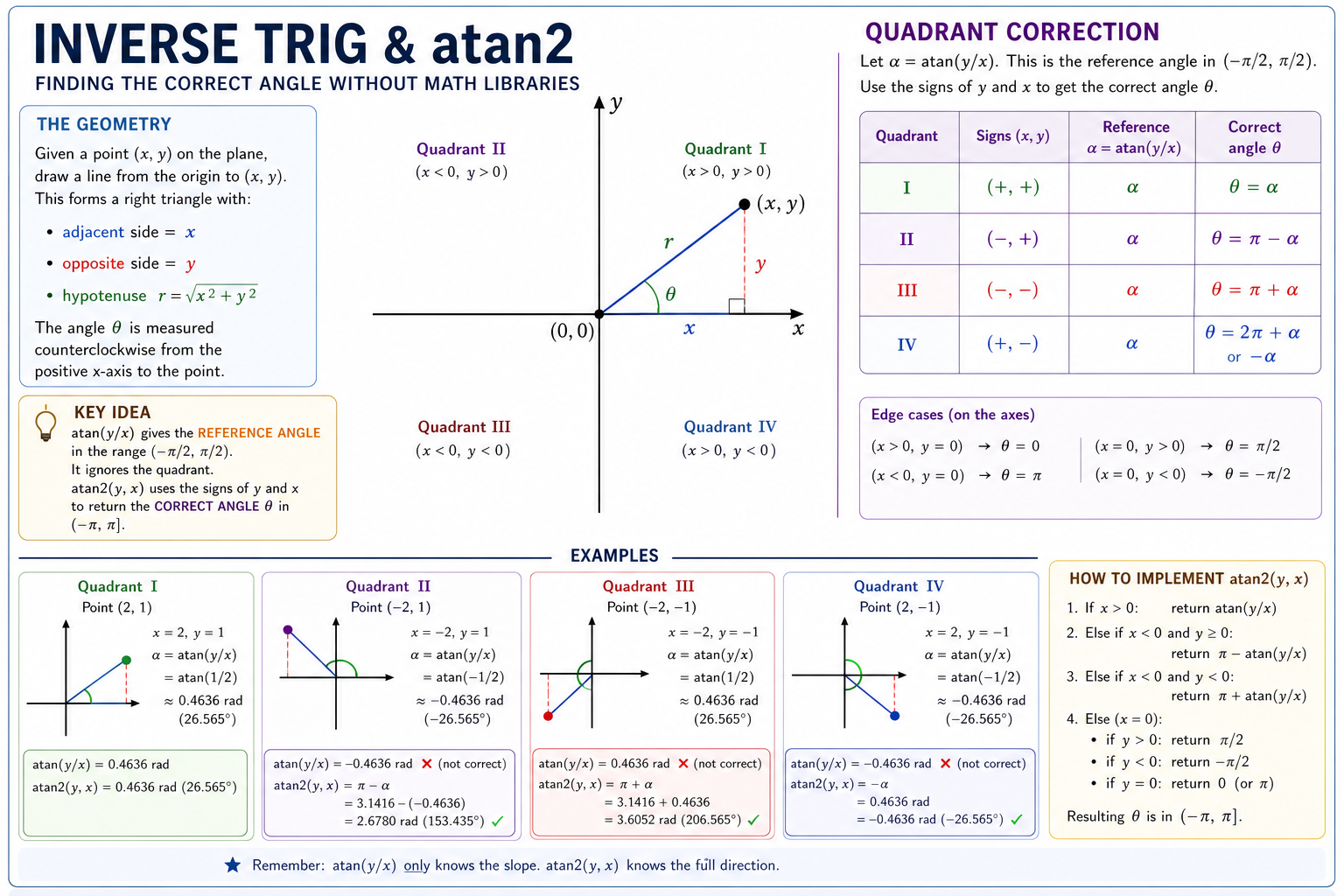
## Plain English first
Regular trig starts with an angle and gives you a point.
**Inverse trig goes the other direction**: you have a point and you want the angle.
Imagine you know where something is on screen — you have its x and y position. Inverse trig tells you the angle you'd need to face to look directly at it.
## The picture
Given a point `(x, y)`, draw an arrow from the origin to the point. The angle `θ` is measured from the positive x-axis (pointing right) counterclockwise to your arrow.
```text
y
| * (x, y)
| /
| / ← θ is this angle
|/_________ x
```
## Standard math notation
```text
θ = arctan(y / x) ← basic, loses quadrant info
θ = atan2(y, x) ← correct, uses both signs
```
## Why atan2 exists
`arctan(y/x)` has a problem: the same ratio can come from two opposite quadrants.
For example, `(-3, -4)` and `(3, 4)` both give `y/x = -4/-3 = 4/3`. But they point in completely opposite directions.
`atan2(y, x)` fixes this by looking at the **signs** of x and y separately.
## Verbose Python with descriptive names
```python
def find_angle_from_point(x_coordinate, y_coordinate):
"""
Given a point at (x, y), find the angle in radians from
the positive x-axis to the arrow pointing at that point.
Uses atan2 logic to correctly handle all four quadrants.
Returns an angle between -π and +π radians (-180° to 180°).
"""
# Handle the special case where the point is at the origin
if x_coordinate == 0 and y_coordinate == 0:
return 0 # no direction defined
# Use the basic arctangent for the magnitude of the angle
if x_coordinate != 0:
basic_angle = arctangent_approximation(y_coordinate / x_coordinate)
else:
# Pointing straight up or down
PI = 3.141592653589793
return PI / 2 if y_coordinate > 0 else -PI / 2
PI = 3.141592653589793
# Adjust the quadrant based on signs of x and y
if x_coordinate > 0:
# Quadrant I (x+, y+) or Quadrant IV (x+, y-)
# basic_angle is already correct
final_angle = basic_angle
elif x_coordinate < 0 and y_coordinate >= 0:
# Quadrant II: x is negative, y is positive or zero
# The basic angle is negative here; add π to flip to correct side
final_angle = basic_angle + PI
else:
# Quadrant III: x is negative, y is negative
# Subtract π to get the correct negative angle
final_angle = basic_angle - PI
return final_angle
def angle_to_degrees(angle_in_radians):
PI = 3.141592653589793
return angle_in_radians * 180 / PI
```
## Worked example
```python
# Enemy is at position (3, 4). You are at origin. What angle do you face?
enemy_x = 3
enemy_y = 4
angle_radians = find_angle_from_point(enemy_x, enemy_y)
angle_degrees = angle_to_degrees(angle_radians)
# angle_degrees ≈ 53.1°
# Same for the opposite direction:
angle_radians = find_angle_from_point(-3, -4)
angle_degrees = angle_to_degrees(angle_radians)
# angle_degrees ≈ -126.9° ← correctly in Quadrant III
```
## Common mistakes
- Using `atan(y/x)` instead of `atan2(y, x)` — you lose quadrant information and get wrong angles half the time.
- Forgetting that `atan2` takes `(y, x)` order, not `(x, y)`. The y comes first in almost every language.
- Not handling `x == 0` before dividing — causes division by zero.
## See also
- [Visual Tangent Without Math Libraries](/articles/79e757c8-e0c8-44b1-b6ad-07587c459af5)
- [Visual Unit Circle Sine and Cosine Without Math Libraries](/articles/ad8e2329-c2a5-4f28-a4fb-251496ff9069)
- [Visual Angle Wrapping](/articles/0acc962a-66da-4990-8014-8fd781b9de25)
- [Visual Geometry and Trigonometry — Table of Contents](/articles/6e6fe0ba-ee87-48bd-9734-6fc7196323ac)