

 Web search
 Links
Links Notes
Notes Files
Files Articles
 Contacts
 Home
Home Dashboard
 Tasks
Tasks Projects
 Messages
 Events
 Time tracker
 Forum
Forum Documentation
 Shell
Shell Workers
 Templates
 AI dashboard
 AI usage
 APIs & MCP
 Objects
# Zero — The Number That Changed Everything
## Plain English first
Zero is the number that means "none." It answers the question "how many?" when the answer is: not one single thing.
This sounds obvious, but zero was one of the hardest ideas in the history of mathematics. Many ancient civilizations — the Egyptians, the Greeks, the Romans — had no zero. They could count things, but had no symbol for the absence of things.
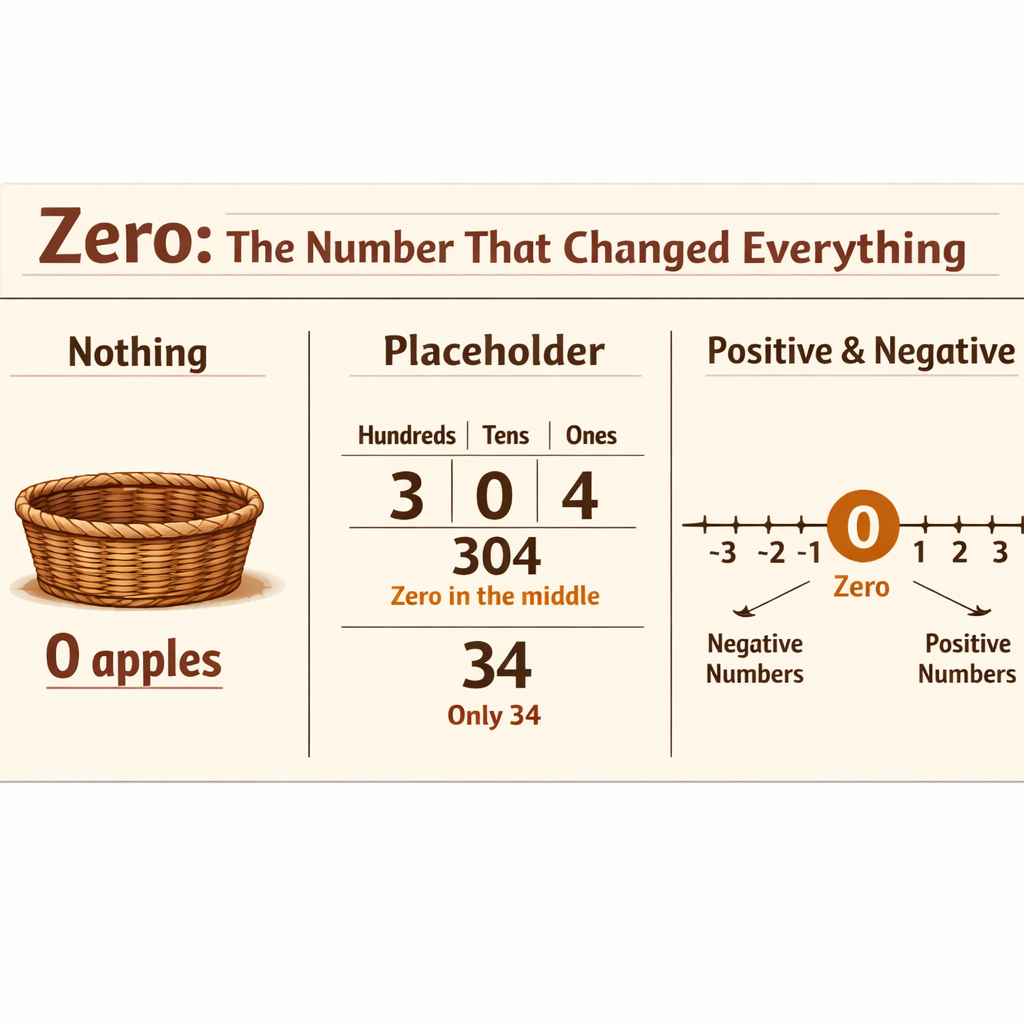
Zero does three distinct jobs:
1. **Zero as nothing** — the count of an empty collection (0 apples)
2. **Zero as placeholder** — marking an empty column in place value (the 0 in 304)
3. **Zero as origin** — the center point of the number line, separating positive from negative
## Standard math notation
```text
0 + n = n (adding zero changes nothing)
0 × n = 0 (multiplying by zero always gives zero)
n - n = 0 (a number minus itself is zero)
n / 0 = undefined (dividing by zero has no answer)
n⁰ = 1 (any number to the power zero is one)
```
## Verbose Python with descriptive names
```python
def demonstrate_zero_as_nothing():
"""Zero as nothing: the size of an empty collection."""
empty_basket = []
number_of_items = len(empty_basket)
print(f"Items in basket: {number_of_items}") # 0
def demonstrate_zero_as_placeholder(number_with_gap):
"""
Zero as placeholder: the 0 in 304 means 'zero tens here.'
Without it, 304 and 34 would be indistinguishable.
"""
column_names = ["ones", "tens", "hundreds", "thousands"]
for position, digit in enumerate(reversed(str(number_with_gap))):
print(f" {column_names[position]} column: {digit}")
def demonstrate_zero_as_origin():
"""Zero as origin: the center of the number line."""
for number in [-3, -1, 0, 1, 3]:
distance = abs(number)
direction = "right" if number > 0 else ("left" if number < 0 else "IS zero")
print(f" {number:3d} → {distance} units {direction}")
def show_zero_arithmetic_rules():
n = 7
print(f"{n} + 0 = {n + 0}") # 7
print(f"{n} - {n} = {n - n}") # 0
print(f"{n} × 0 = {n * 0}") # 0
try:
n / 0
except ZeroDivisionError:
print(f"{n} / 0 = undefined")
```
## Why dividing by zero is undefined
`12 / 3` asks: how many groups of 3 fit into 12? The answer is 4.
`12 / 0` asks: how many groups of 0 fit into 12? No matter how many groups of nothing you add, you never reach 12. There is no answer — it is undefined, not infinity.
## Common mistakes
- **Zero is not "nothing" in all contexts.** As a placeholder in 304, it is doing critical work.
- **Zero is not the smallest number.** Negatives go below zero without end.
- **Any number to the power zero is 1**, not 0. (`7⁰ = 1`)
## See also
- [What Is a Number?](/articles/8510b9a8-a3ad-4790-a928-b2360ac8679e)
- [Base 10 and Place Value](/articles/c92b632e-0356-4d27-9bca-8934e7651133)
- [The Number Line](/articles/257eeafa-b654-40a8-97f5-6be800ad1c8e)
- [Negative Numbers](/articles/45845a19-1e29-4a92-8cdd-7bc20ae05a20)
- [Math Foundations — Visual Table of Contents](/articles/d404884f-54fc-4289-b3f1-baaad2bec6b2)