

 Web search
 Links
Links Notes
Notes Files
Files Articles
 Contacts
 Home
Home Dashboard
 Tasks
Tasks Projects
 Messages
 Events
 Time tracker
 Forum
Forum Documentation
 Shell
Shell Workers
 Templates
 AI dashboard
 AI usage
 APIs & MCP
 Objects
# Visual Angle Wrapping
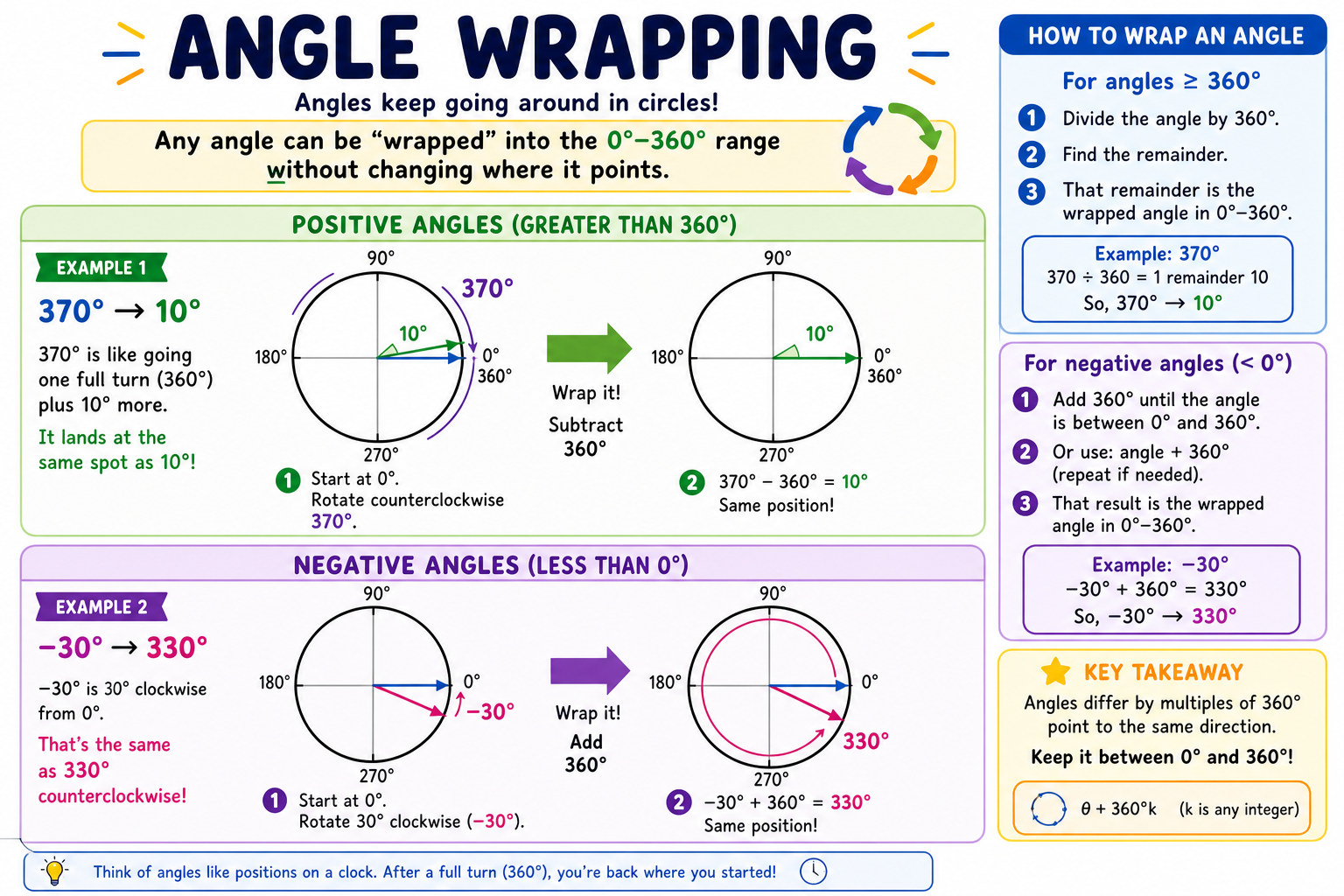
## One picture
Angles work like a clock. After a full turn, you point in the same direction again.
No matter how many full rotations you add or subtract, the direction stays the same.
## Simple idea
Directions repeat every **360°** (or **2π radians**).
Examples:
- `450° = 90°` (one extra full turn)
- `810° = 90°` (two extra full turns)
- `-270° = 90°` (three-quarter turn backward)
- `90° + 720° = 90°` (two full turns forward)
## Programming idea
Use the modulo operator to keep rotation values bounded.
```python
def wrap_degrees(angle):
"""Wrap to [0, 360)"""
return angle % 360
def wrap_radians(angle):
"""Wrap to [0, 2π)"""
TAU = 6.283185307179586
return angle % TAU
```
For rotation where you want values centered on zero (e.g., -180 to +180):
```python
def wrap_signed_degrees(angle):
"""Wrap to (-180, 180]"""
return ((angle + 180) % 360) - 180
def wrap_signed_radians(angle):
"""Wrap to (-π, π]"""
PI = 3.141592653589793
TAU = 2 * PI
return ((angle + PI) % TAU) - PI
```
## Why it matters in games and simulations
A game object can rotate for minutes or hours, accumulating floating-point drift. Wrapping keeps the value bounded and prevents precision loss over time.
```python
# Bad: spacecraft.heading grows forever
spacecraft.heading += rotation_speed * dt
# Good: stays in [0, 360) always
spacecraft.heading = (spacecraft.heading + rotation_speed * dt) % 360
```
## Angle difference
Finding the shortest rotation between two angles is a common bug source:
```python
def shortest_angle_diff(a, b):
"""Returns the signed shortest rotation from a to b, in degrees."""
diff = (b - a + 180) % 360 - 180
return diff
# Example: from 350° to 10° should be +20°, not -340°
print(shortest_angle_diff(350, 10)) # 20.0
print(shortest_angle_diff(10, 350)) # -20.0
```
## Common mistakes
- Adding angles without wrapping, causing values like `3600°` or `100 * 2π`.
- Comparing unwrapped angles: `if heading == target` can fail when both represent the same direction but with different accumulated turns.
- Forgetting that `% 360` in Python always returns a positive value, but in some languages `%` returns negative for negative inputs.
## See also
- [Visual Degrees vs Radians](/articles/4bc70fd7-fa6e-4989-988f-834ff34babdf)
- [Visual Radians Without Math Libraries](/articles/7090a8d6-5f02-456e-82ec-31741bd1fe38)
- [Visual Inverse Trig and atan2 Without Math Libraries](/articles/85a06148-c2a9-429d-93e4-3b8ffcb93089)